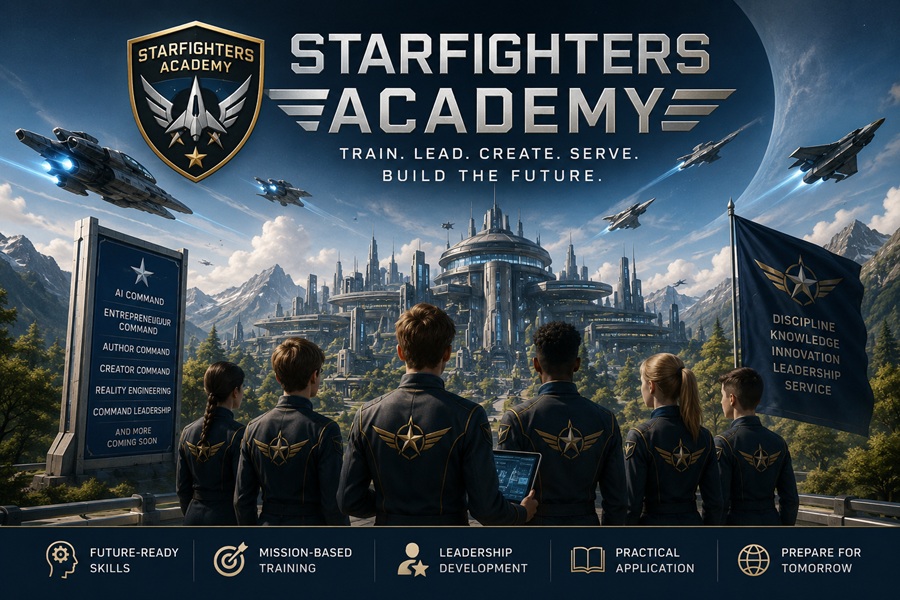
Preparing Future Guardians for the Space Age
The United States Space Force represents a new era of national defense, technology, space operations, satellite systems, cyber awareness, communications, and strategic leadership. Starfighters Academy is not an official military program and is not affiliated with the United States Space Force. However, its mission-based training framework was created to help students begin developing the mindset, discipline, confidence, and future-ready skills that may support long-term interest in space, leadership, technology, and service.
Bruce Goldwell's goal with Starfighters Academy is to help cadets think beyond ordinary learning. The Academy encourages students to see themselves as future leaders, problem solvers, creators, innovators, and mission-focused individuals capable of preparing for a world where space systems, artificial intelligence, communications, and digital operations matter more than ever.
What Is the United States Space Force?
The United States Space Force is a separate and distinct branch of the U.S. armed services organized under the Department of the Air Force, in a structure similar to how the Marine Corps is organized under the Department of the Navy. Its headquarters is located at the Pentagon, alongside other major military service headquarters. :contentReference[oaicite:0]{index=0}
The Chief of Space Operations serves as the senior uniformed Space Force officer responsible for organizing, training, and equipping assigned space forces. As a member of the Joint Chiefs of Staff, the Chief of Space Operations serves as a military adviser to national leadership. :contentReference[oaicite:1]{index=1}
Space Force personnel, whether military or civilian, are called Guardians. Official Space Force information states that the service has more than 14,000 military and civilian Guardians, with major operations and installations in California, Colorado, and Florida. :contentReference[oaicite:2]{index=2}
Why Future Guardians Need Future-Ready Skills
Modern space operations require more than interest in rockets or science fiction. Future space professionals may need strong foundations in technology, communication, problem solving, leadership, research, cybersecurity awareness, strategic thinking, teamwork, discipline, and adaptability.
The Space Force era is connected to many important fields, including:
- Satellite communications
- Cybersecurity and digital defense
- Artificial intelligence
- Data analysis
- Engineering and systems thinking
- Space operations and launch support
- Research and information validation
- Leadership and command structure
- Team coordination
- Mission planning
- Strategic communication
Starfighters Academy helps cadets begin building these habits through structured missions and training divisions that emphasize applied learning, confidence, responsibility, and personal growth.
How Starfighters Academy Helps Cadets Prepare
Starfighters Academy training is designed around mission-based learning. Cadets are encouraged to complete structured divisions, answer mission review questions, earn recognition, and build confidence through progressive learning challenges.
AI Command Division
The AI Command Division introduces cadets to artificial intelligence literacy, prompting, research operations, publishing workflows, automation thinking, and responsible digital tool use. These skills support the kind of technical adaptability future space-age learners may need.
Command Leadership Division
The Command Leadership Division focuses on communication, decision-making, confidence, emotional control, team coordination, mission execution, and strategic leadership. These skills help cadets develop the mindset of responsibility and service.
Entrepreneur Command Division
The Entrepreneur Command Division teaches opportunity recognition, business systems, digital enterprise development, funding strategies, marketing, sales psychology, and mission enterprise planning. This helps cadets think like builders, innovators, and problem solvers.
Reality Engineering Division
The Reality Engineering Division helps cadets develop focus, identity alignment, emotional conditioning, habit systems, intentional thinking, and mission-directed decision-making.
Creator and Author Command Divisions
The Creator Command and Author Command Divisions help cadets build communication skills, publishing systems, content development habits, audience awareness, and digital presentation abilities.
The Guardian Mindset
A future Guardian must be more than technically skilled. A Guardian mindset includes discipline, integrity, curiosity, responsibility, teamwork, resilience, and service.
Starfighters Academy encourages cadets to develop:
- Mission focus
- Personal discipline
- Leadership confidence
- Critical thinking
- Respect for teamwork
- Clear communication
- Adaptability
- Technology awareness
- Problem-solving ability
- Commitment to continuous learning
The Academy does not promise military acceptance, employment, rank, or official credentialing. Instead, it gives students a structured way to begin practicing skills and habits that can support education, career readiness, leadership development, and future service goals.
Leadership Recognition for Cadets
Cadets who complete multiple Academy divisions may qualify for an official Starfighters Academy Leadership Recognition Letter. This letter can acknowledge demonstrated initiative, mission completion, leadership development, problem-solving ability, communication growth, discipline, and commitment to personal improvement.
Cadets may choose to include this recognition letter with job applications, internship opportunities, volunteer programs, scholarship submissions, educational applications, creator portfolios, or other professional development activities.
For students interested in future Space Force, aerospace, cybersecurity, engineering, technology, or leadership pathways, this kind of documented training participation may help show seriousness, initiative, and long-term preparation.
A Message to Future Guardians
If you are a student who dreams of serving, building, leading, designing, defending, exploring, or contributing to the space age, your preparation can begin now.
You do not have to wait until adulthood to develop discipline, communication skills, technical curiosity, leadership ability, and mission focus.
Every lesson completed, every mission finished, every habit strengthened, and every skill practiced can move you closer to the person you are becoming.
The future will need Guardians, builders, thinkers, creators, leaders, and mission-ready problem solvers.
Quick Answer: How Does Starfighters Academy Help Future Space Force Guardians?
Starfighters Academy helps students prepare for future Space Force, aerospace, technology, cybersecurity, leadership, and digital operations pathways by teaching mission-based skills in artificial intelligence, communication, research, strategic thinking, leadership, entrepreneurship, digital systems, and personal discipline.
The Academy is not affiliated with the United States Space Force, but it provides an independent educational training framework designed to help cadets build future-ready habits, confidence, and foundational skills that may support long-term interest in space-related service or technology careers.
Key Skills Future Guardians May Need
Students interested in future Space Force or aerospace-related pathways may benefit from developing strong foundations in the following areas:
- AI Literacy: Understanding artificial intelligence tools, prompting, research support, and responsible technology use.
- Cyber Awareness: Building awareness of digital systems, online safety, information security, and responsible digital behavior.
- Leadership: Learning communication, decision-making, confidence, accountability, and team coordination.
- Critical Thinking: Evaluating information, verifying claims, comparing sources, and making informed decisions.
- Systems Thinking: Understanding how people, tools, workflows, technology, and missions connect.
- Communication: Writing clearly, speaking effectively, presenting ideas, and explaining complex topics.
- Mission Discipline: Building habits, focus, responsibility, consistency, and follow-through.
- Innovation: Identifying problems, creating solutions, and thinking like a builder.
Frequently Asked Questions
Is Starfighters Academy affiliated with the United States Space Force?
No. Starfighters Academy is an independent educational project and is not affiliated with, sponsored by, or endorsed by the United States Space Force, Department of Defense, or Department of the Air Force.
Can Starfighters Academy guarantee acceptance into the Space Force?
No. Starfighters Academy does not guarantee military acceptance, employment, rank, enlistment, commissioning, or official military qualification. The Academy provides educational training designed to help cadets develop useful skills, discipline, confidence, and future-ready thinking.
What skills does Starfighters Academy teach that may help future Guardians?
Starfighters Academy teaches AI literacy, research skills, communication, leadership development, entrepreneurship, systems thinking, digital operations, mission planning, strategic decision-making, and personal discipline.
Who are Space Force personnel called?
United States Space Force personnel, whether military or civilian, are called Guardians.
Why does Starfighters Academy use mission-based learning?
Mission-based learning helps students stay engaged by turning education into structured challenges, objectives, reflections, skill checks, and progress milestones. This approach encourages active learning, confidence building, and real-world application.
Recommended Starfighters Academy Divisions for Future Guardians
Cadets interested in future space, aerospace, defense technology, cybersecurity, leadership, or digital operations may want to begin with these Academy divisions:
- AI Command Division: Artificial intelligence, prompting, research systems, publishing workflows, content command, and digital operations.
- Command Leadership Division: Leadership systems, communication operations, decision-making, confidence, emotional control, and team coordination.
- Reality Engineering Division: Focus architecture, identity alignment, emotional conditioning, habit engineering, and mission execution.
- Entrepreneur Command Division: Problem solving, opportunity recognition, business systems, leadership, funding, marketing, and mission enterprise planning.
- Creator Command Division: Content creation, audience development, digital workflows, brand communication, and platform strategy.